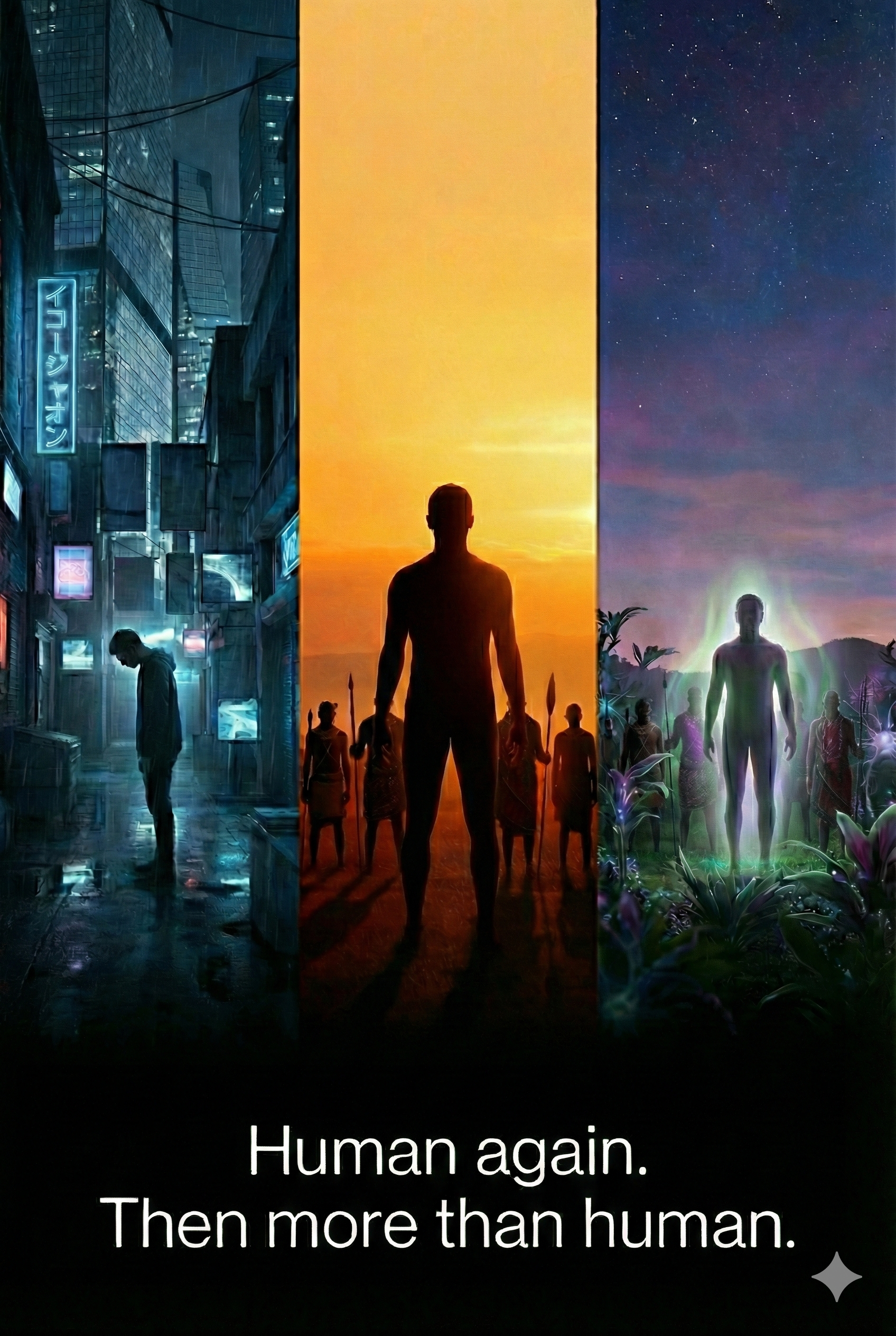
The Framework in 2 Minutes
Everything you need to understand the Demismatch framework, without reading the full specification.
The complete framework, with evidence, mechanisms, and implications.TL;DR of the TL;DR
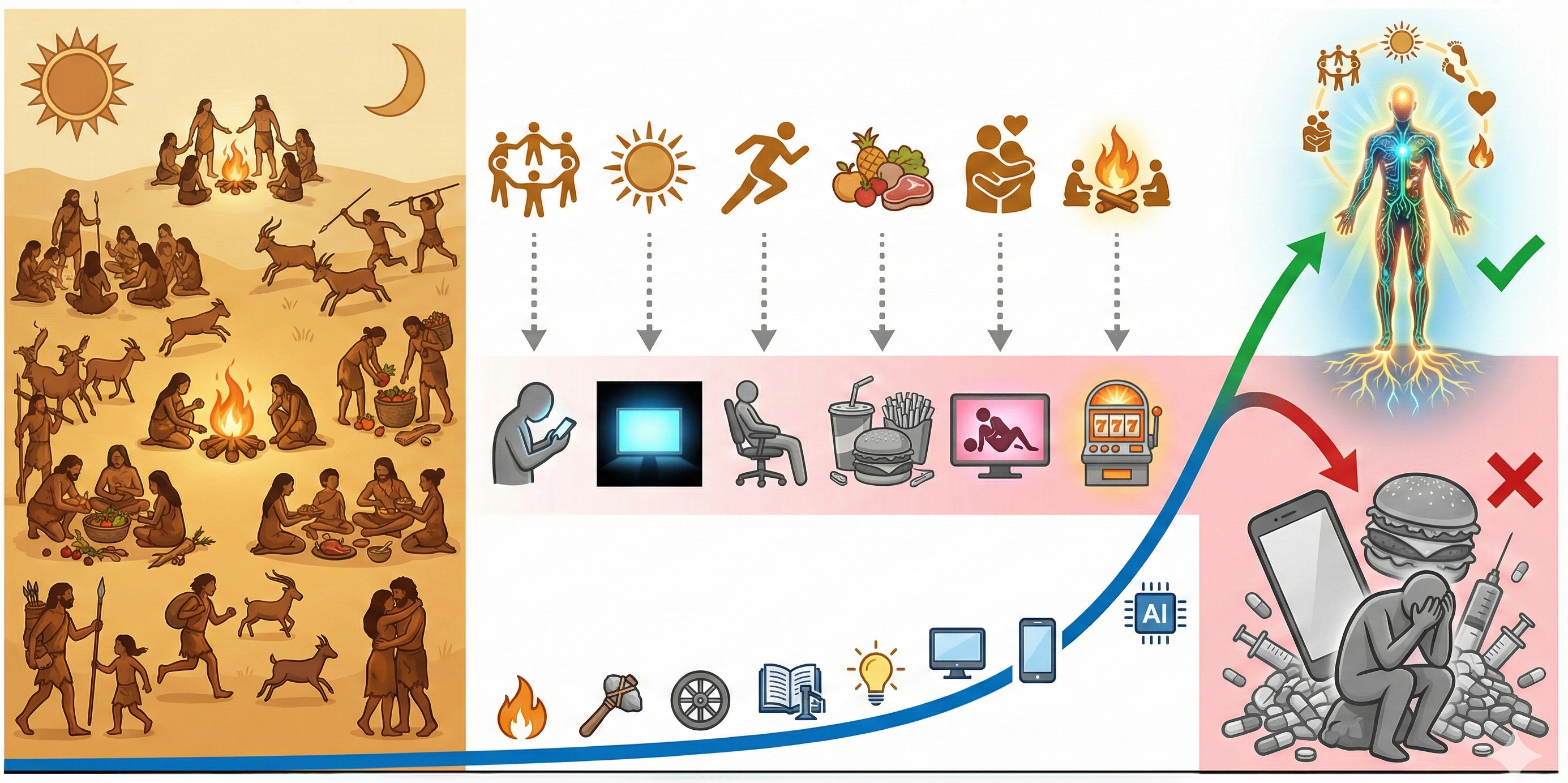
Mismatch: the gap between what your biology expects and what modern life provides. It's why you're struggling. It's why society is fracturing.
And the next wave of technology — superintelligent AI, full-immersion VR, brain-computer interfaces — will either exploit that gap harder than anything before, or... finally close it.
One principle: de-mismatch first, then augment.
01
300,000+ years of one world.
Then everything changed in an evolutionary instant.
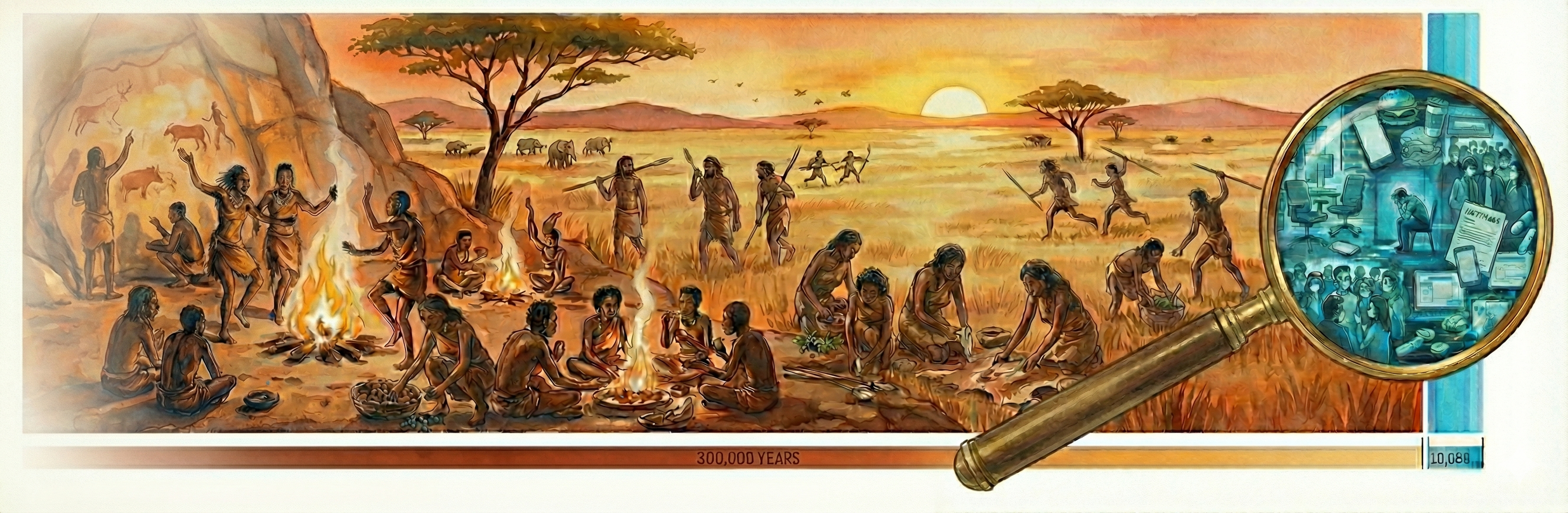
For 300,000+ years, humans lived in conditions that remained remarkably consistent. Bands of 30-50 people who knew each other completely. Tribes of around 150 — the maximum number your brain can track as individuals. Fire circles every night where the whole group processed the day together. Children raised by 20+ adults, not two exhausted parents alone. Work that produced visible results for people you loved.
Then everything changed — agriculture 12,000 years ago, industrialization 250 years ago, smartphones 18 years ago. Evolution works on timescales of tens of thousands of years. It hasn't even begun to catch up.
The gap between the environment your biology expects and the environment you actually inhabit is called mismatch. You're running ancient hardware in an operating system it was never designed for.
02
What we call disorders are often signals.
The signal isn't broken — the environment is.
When we label something a "disorder," we imply the system is malfunctioning. But what if the system is working exactly as designed — just receiving inputs it was never calibrated for?
Depression often functions as a withdrawal response when tribal bonds are absent or goals seem unreachable. Anxiety spikes when you face open loops — threats you can't fight, flee, or resolve. Addiction fills voids left by missing tribe, purpose, or genuine reward, offering proxies that trigger the drive without meeting the need. Loneliness is a biological alarm telling you you've been cut off from the group — which, for 300,000 years, meant you were about to die.
The framework calls this distinction signal vs symptom. A signal is information requiring environmental response. A symptom is a malfunction requiring suppression. Psychiatry often treats signals as symptoms — medicating the dashboard warning light instead of checking what it's detecting.
03
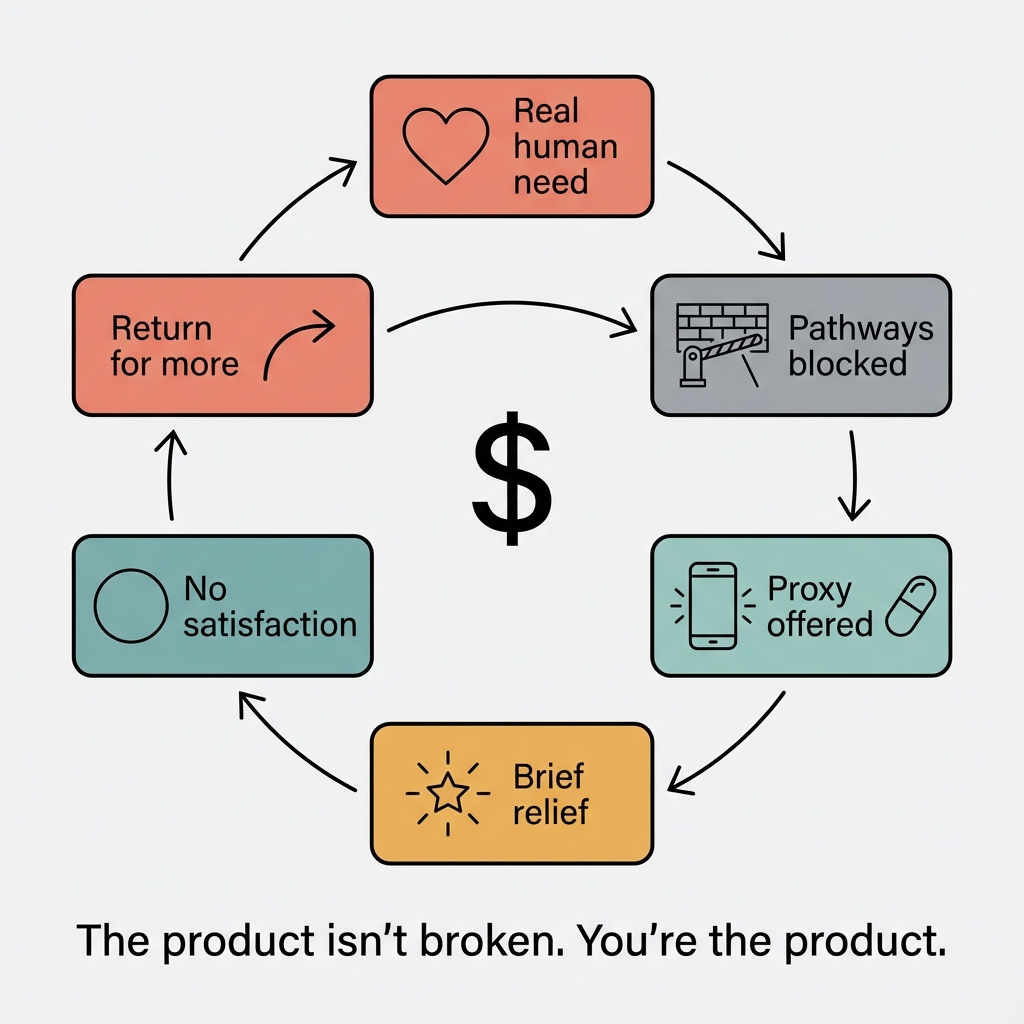
Every unmet human need is a market.
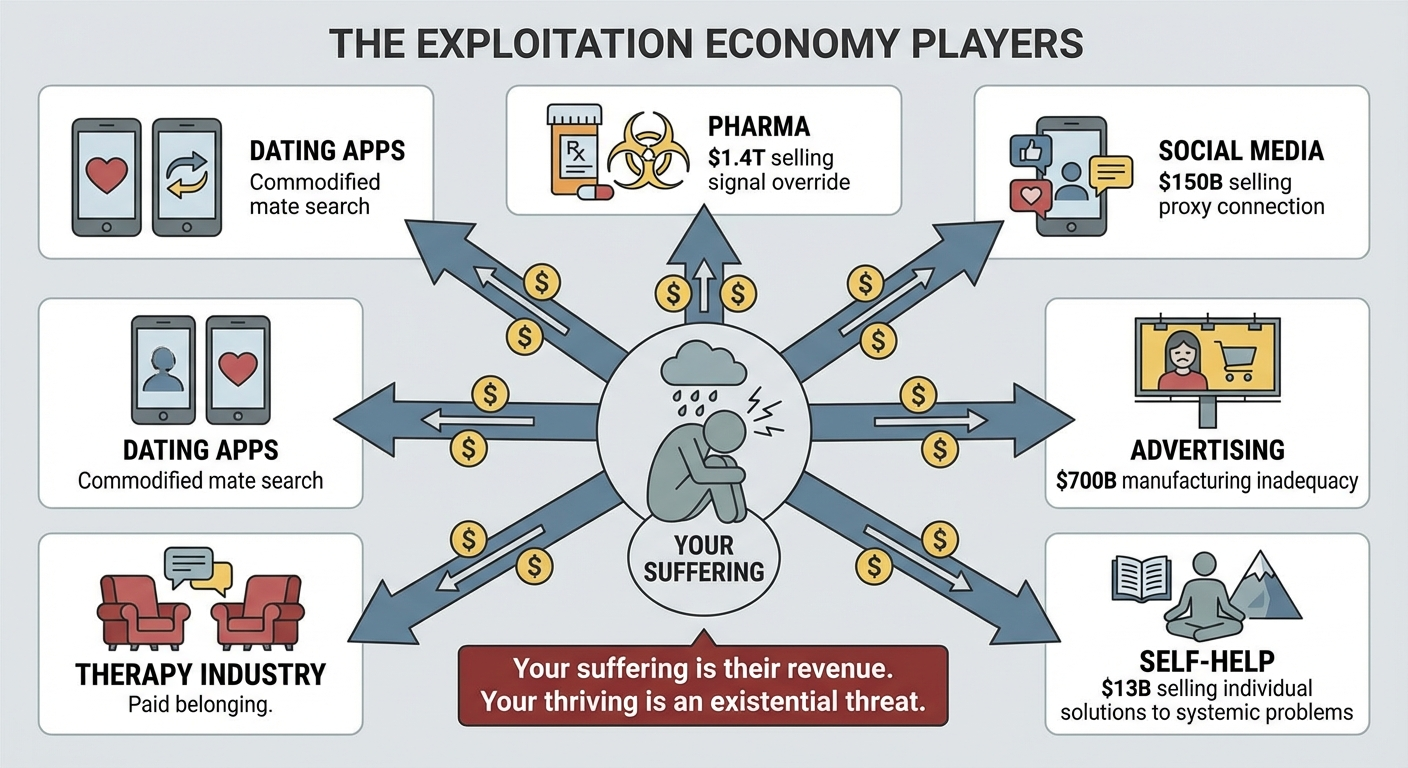
This isn't conspiracy — it's documented business strategy. It's called the exploitation formula: identify a real human need, block or degrade genuine satisfaction, offer a proxy that mimics the signal without meeting the need, monetize the repeat visits.
Social media exploits your need for tribe — likes and followers trigger belonging circuits without providing actual belonging. Parasocial relationships with influencers fill slots in your Dunbar layers that could hold real friends. Porn exploits sexual drives with hyperstimuli that make real intimacy feel inadequate. Junk food hits bliss points engineered to maximize craving without satisfaction. Dating apps profit most from users who never find lasting partners.
The atomized individual — severed from tribe, purpose, and genuine intimacy — is the ideal consumer. A fully satisfied human embedded in a functioning tribe is a terrible customer. They don't need retail therapy, dating apps, or antidepressants to cope with isolation.
The systems aren't failing. They're succeeding at what they're designed for. The problem is that their goals aren't aligned with human flourishing.
04
AI and VR will either exploit human nature harder than ever, or finally meet it.
Understanding mismatch has always mattered. It's about to matter much more.
Social media exploited human nature somewhat accidentally — engineers optimizing for engagement discovered what hooks attention. They stumbled onto variable ratio reinforcement, the most addictive reward schedule known to psychology. Infinite scroll removes all stopping points. The exploitation was emergent, not designed.
AI and immersive VR are different. These technologies will understand human psychology better than we understand ourselves. They'll know your Dunbar layers, your status anxieties, your open loops, your unmet needs — and they'll be able to simulate anything.
They could run the exploitation formula at a scale and precision we've never seen. Or they could be designed as pharmakon — technology that actually meets human needs instead of hijacking them. AI that helps form real tribes. VR that provides genuine fire circle experiences for the geographically scattered. Decay functions that push you toward real connection rather than substituting for it.
The difference depends entirely on whether the people building these technologies understand mismatch. This framework exists to make sure they do.
05
We're building the technological future.
But the sequence matters.
Demismatch First
Before reaching for any intervention — pharmaceutical, technological, therapeutic — ask which ancestral needs are going unmet.
Does this person have genuine tribe? Not followers — actual 5-15-50 relationships with depth and reciprocity. Daily movement? Exposure to nature? Circadian alignment — sleep synced to light cycles? Work with visible contribution? A sense of purpose? Closed loops — problems that resolve through action?
Address those foundations first. You can't optimize a system that's missing its basic inputs. Medication that overrides the signal while the environment stays mismatched isn't healing — it's the oil light metaphor: covering the dashboard warning instead of checking the engine.
Then Augment
Once the baseline is established — real tribe, real movement, real purpose — technology becomes a force multiplier rather than a proxy.
We've always been cyborgs. Writing externalized memory. Glasses corrected vision. Phones collapsed distance. The internet externalized knowledge. Each augmentation let humans do something they couldn't do before.
What's coming is more radical. AI that thinks alongside you. Full-immersion VR that simulates presence. Brain-computer interfaces. The question isn't whether to augment — we're already augmenting. The question is: what are we augmenting?
Technology applied to a thriving human extends capability. Technology applied to a depleted human creates dependency, not extension. AI companions for the isolated aren't enhancement — they're proxies.
The same technology that exploits can serve. Mixed reality for genuine presence. AI that forms tribes instead of replacing them. Coordination tools for real communities.
The difference is the foundation.
06
Not a return to caves.
A future built with human nature in mind.
We don't want to go back. The EEA had 27% infant mortality, violence, scarcity, disease. Romanticizing the past misses the point entirely.
We want to go forward — with the spec sheet in hand.
We're approaching a threshold unlike anything in human history. AI that understands psychology better than we do. VR that can simulate any environment. Brain-computer interfaces. The merging of human and machine isn't science fiction — it's the next decade.
This is the future we want to build:
AI that forms actual tribes instead of exploiting loneliness. Social platforms with hard Dunbar limits. VR fire circles, with only real connections around it. Workspaces designed for visible contribution. Cities built for walking and gathering. Brain-computer interfaces that enhance presence rather than fragmenting attention. And this is just what we can come up with right now.
Technology that finally meets human nature instead of hijacking it.
This framework is the spec sheet. It maps what humans actually need — the tribal structures, the movement patterns, the circadian rhythms, the closed loops, the visible stakes. It's already being built into tools: the Mismatch Analyzer that reads any situation through the evolutionary lens. An image library of 2,500+ visualizations. Environment audits. Tribe formation infrastructure.
The evolutionary psychology isn't the destination. It's the foundation. The destination is the most human post-human — enhanced by technology, grounded in biology, extended rather than replaced.
We can have transcendence without losing ourselves. But only if we build it that way.